- calendar_today August 20, 2025
.
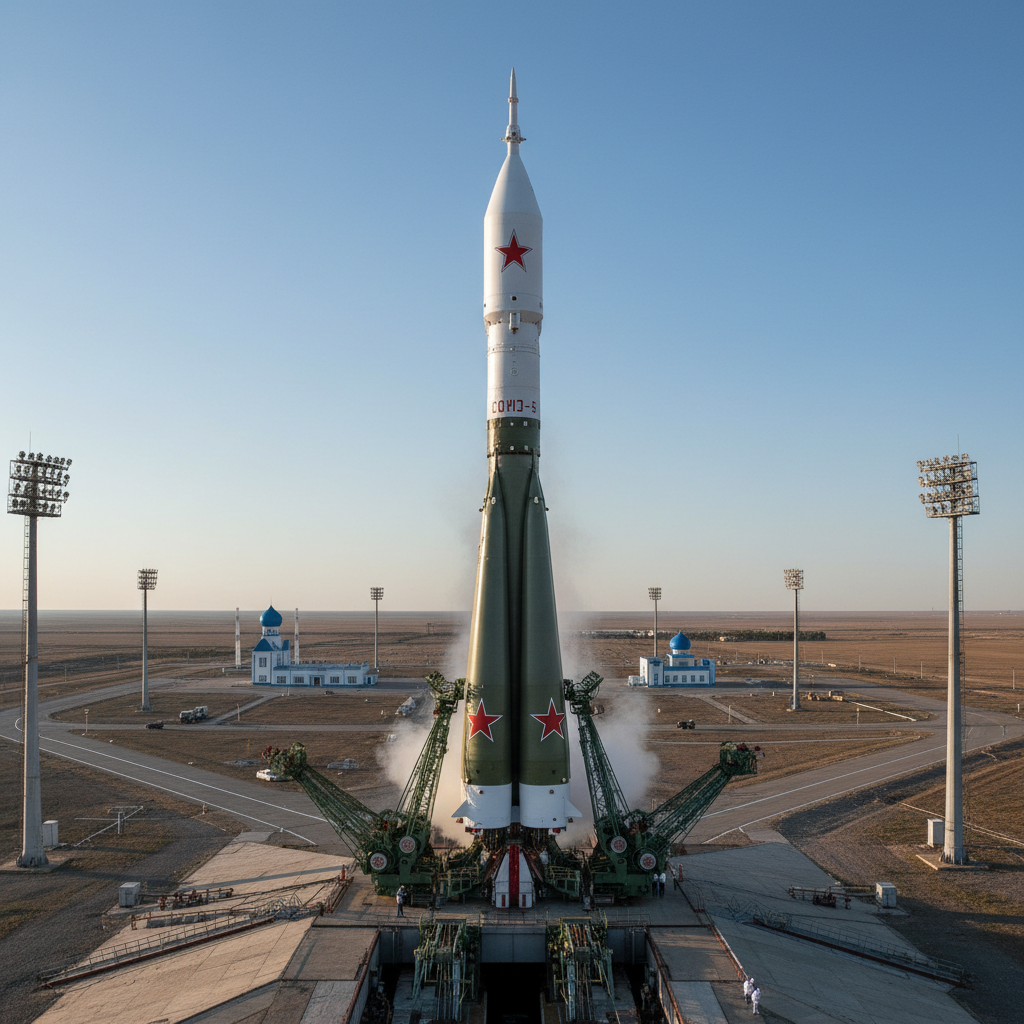
Russia is gearing up for a launch of the latest iteration of its Soyuz rockets before the end of the year. Head of Russian space agency Roscosmos Dmitry Bakanov made the announcement in an interview with state-owned news agency TASS.
“Yes, we are planning for December,” Bakanov told TASS. “In terms of design and manufacturing of this rocket, work is practically complete. The spacecraft is ready for the first launch, which, as I said, will take place from the Baikonur spaceport.” Bakanov added that several trial launches would take place before entering service, with full-rate production only expected by 2028.
Conceptually, Soyuz-5 (or Irtysh, as it’s sometimes known) isn’t new. Roscosmos based much of its design on the Zenit-2 rocket, an old design from the 1980s that was developed by Ukraine’s Yuzhnoye Design Bureau. Zenit rockets were manufactured in Ukraine, but relied on engines built in Russia for propulsion. The pair of launchers represents an unusual example of Russian-Ukrainian cooperation after the Soviet collapse. That détente ended in 2022, after Russia invaded Ukraine. By late 2023, Moscow had targeted the Ukrainian plant that assembled Zenit rockets with a missile strike.
Roscosmos has since replaced its Zenit collaboration with the new Soyuz-5 rocket. A domestically manufactured product, the new rocket is, essentially, a stretched version of its predecessor. Roscosmos made no secret of this during the initial phases of the project, with Bakanov describing it as a “bridging” rocket between older systems like Soyuz and future launchers like the Amur rocket.
The biggest difference, and one that Roscosmos has touted as a major step toward self-sufficiency, is the absence of Ukrainian parts. Soyuz-5 has a larger propellant tank than Zenit and a larger payload fairing. At its core is a single RD-171MV engine, the newest member of a long-running engine family that was once shared by Zenit.
This engine dates back to the Soviet Energia rocket program of the 1980s. Energia, which was part of the Soviet space shuttle Buran program, still holds the record for the most powerful liquid-fueled rocket engine in service, generating more than three times the thrust of NASA’s Space Shuttle main engine. The Soyuz-5 version of the RD-171MV, for its part, was notable for what it does not contain: Ukrainian components.
Soyuz-5 Is for Now
The Soyuz-5 rocket itself falls into the medium-lift category by technical measures. With a payload capacity of around 17 metric tons to low-Earth orbit, Soyuz-5 punches slightly above its weight compared to Zenit, in part due to a larger propellant tank. Even so, Soyuz-5, like Zenit, is an expendable rocket. Newer competition like SpaceX’s Falcon 9 rocket has been built around reusability.
The difference in approach is stark. Reusability may have long-term cost benefits that make SpaceX and other providers attractive to international customers. The commercial future of Soyuz-5, by contrast, is far less clear.
In terms of near-term needs for Roscosmos, however, Soyuz-5 has a role to play. New rocket programs, especially reusable ones, have proven expensive for Russia to develop in the face of war spending and international sanctions. The new Amur rocket, sometimes referred to as Soyuz-7, was supposed to fill that gap. A design with a reusable first stage and methane-powered engines, Amur was designed to enable Russia to compete with SpaceX’s low-cost approach.
The problem was that Amur never left the design phase. Challenges with engines and other aspects of the project have delayed the launcher’s first launch to no earlier than 2030.
With no alternative available, Soyuz-5 will serve as a stopgap. The new launcher, despite being built on the Soviet past, will enable Roscosmos to keep its space program on track for the time being. It may not get much commercial business, if any, from the international market, but that would be true for pretty much any Russian rocket.
That doesn’t diminish the significance of the upcoming launch, of course. Russia has developed the Soyuz-5 rocket under increasingly challenging circumstances since its first conceptual designs in the late 2010s. The success of an inaugural launch would prove that Roscosmos still has what it takes to get a new rocket onto the launch pad.
Soyuz-5 isn’t a reinvention of the space rocket, either in terms of design or concept. For Roscosmos, however, it still matters. The launch of Soyuz-5 has more to do with independence from technology partners in the past than technology to lead the future. In this sense, Soyuz-5 is not just a symbol of continuity for Roscosmos, but an interim step. It’s the vector between now and whatever comes next, whether that’s Amur or another group of rockets in the works today.