
- calendar_today August 28, 2025
From Billboard to Spotify: KPop Demon Hunters’ Musical Domination
Longlisted for the Korean Film Council’s Best Korean Film Awards, the June release has ascended Netflix’s global rankings to become one of its most-streamed films by non-Korean viewers in two weeks, with more than 33 million views worldwide, debuting in the platform’s top 10 in 93 countries, and currently ranked number two globally. Cosplays of its characters are appearing online, fans are producing artwork, and a second film is the internet’s most clamoured-for request.
That success has seeped into the real world. Since its 20 June release, the two bands it centres on — the virtuous all-girl group Huntr/x and the antagonistic Saja Boys — have landed on music charts, outselling other K-pop idols such as BTS and Blackpink, with seven of their songs featured on the Billboard Hot 100. Huntr/x’s songs also claimed first and second place on Spotify’s US charts, a rare feat for a fictional band.
KPop Demon Hunters follows the three members of Huntr/x — Rumi, Mira, and Zoey — as they navigate international superstardom and a hidden existence as demon slayers whose mission is to save the world from dark forces and preserve the balance of good and evil. Their encounters with the Saja Boys unfurl in spectacular concerts, stylish fight scenes, and a central narrative about friendship, trust, and self-identity. The plot’s fast-paced elements of Korean pop, high-octane action, and digital-age humour have made it one for all, with a blend of comedy, “meaningful nuggets”, and fantastical adventure.
Audiences are also drawn to the storyline, but it’s the soundtrack that has made KPop Demon Hunters a cultural juggernaut. Asked about the film’s influences, Korean-Canadian co-director Maggie Kang said that while growing up, she followed K-pop idols and channelled her admiration for them into the work. Music, in KPop Demon Hunters, is elevated from entertainment to a force of its own to counter the darkness. It also has a central role in the action and is so closely integrated into the characters’ experiences that it drives the narrative rather than intruding on it, says Lashai Ben Salmi, a community leader who focuses on Korean culture and is based in Europe. “It gives the film a surprising level of maturity,” she adds.
Achieving that standard required expert help. Kang and director Chris Appelhans worked with Korean label SM Culture, while Teddy Park, known for his work with Blackpink, and Grammy Award-winning producer Lindgren, who has produced music for BTS and TWICE, both worked on original songs for the project. These tracks, some of which were co-written by the band’s virtual members, sound no different from K-pop idol tracks and are part of a full feature soundtrack.
In Los Angeles, Amanda Golka, who curates and produces Korean content on her YouTube channel that features visual effects and make-up artistry, admits she is not a K-pop follower. “I have been blasting the soundtrack from Spotify every time I’m in the car,” she tells OGW. “It’s fascinating how music can be such a universal language.”
Representation At Its Finest
Authenticity in cultural representation has also been central to the film’s success. K-pop, K-dramas, and Korean cinema have already found audiences in the US and other Western markets, but KPop Demon Hunters’ representation takes it further. The film incorporates elements of daily life, such as Korean dining traditions and dishes, while its iconic Seoul locations include the ancient Korean city wall, the old Hanuiwon healing clinic, traditional Korean bathhouses, and Namsan Tower. It also goes beyond stereotypes and affords Korean audiences respectful and accurate representation that many of them say they rarely see.
The production team visited South Korea to take notes. They travelled to folk villages and mountain towns, took photos of the Myeongdong area, and studied Korean Hanbok and its movements. Many details of Korean culture make their way into the background, the animation, and the action. Although the characters have switched to speaking English in the final cut, their mouth movements correspond to Korean sounds, and their body language and reactions are recognisably Korean. Korean words and song lyrics also feature in some scenes.
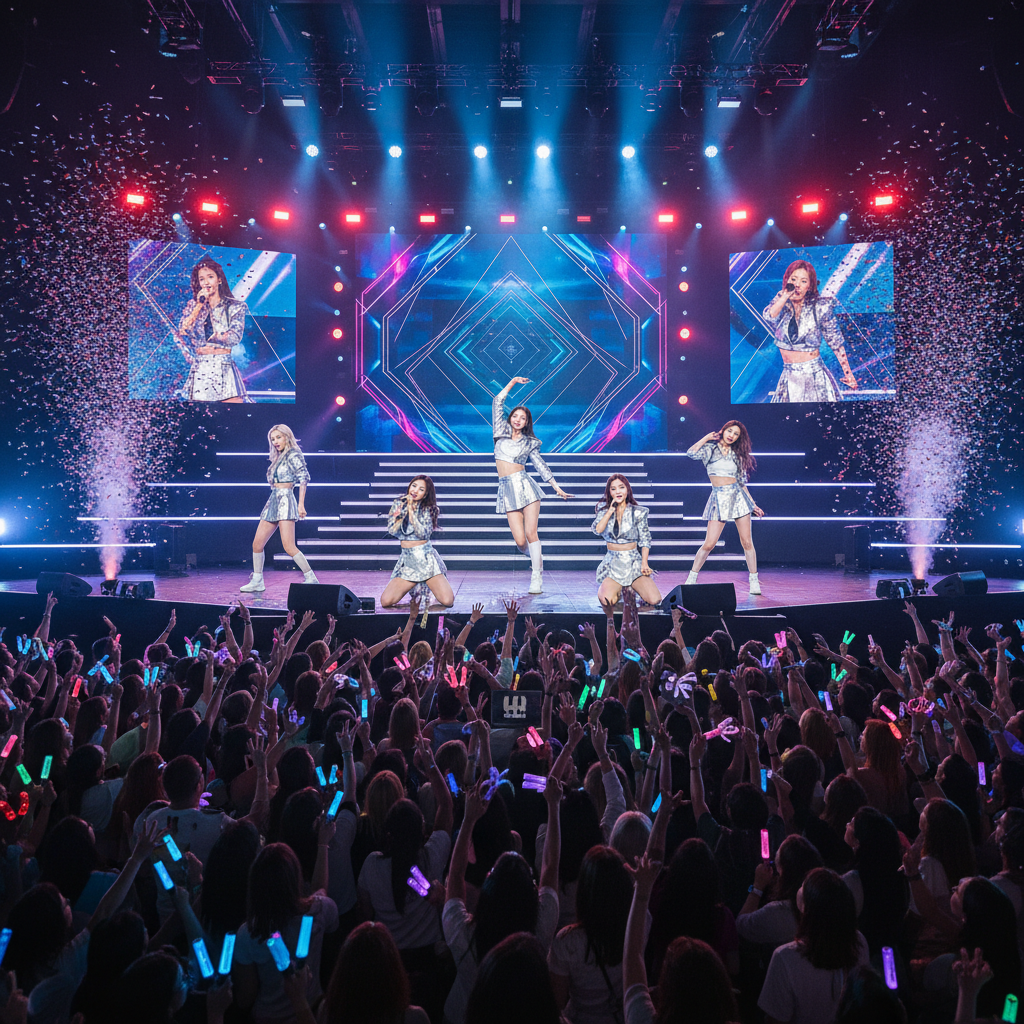
The production has also captured K-pop fandom with nuanced accuracy. The film shows fan signing sessions, the colourful light sticks in the hands of fangirls, Kalgunmu (identical synchronization), Korean placards, and more. But it doesn’t cater to a single fandom or K-pop era; instead, it represents the culture as a whole. This makes it appealing to both casual viewers and K-pop die-hards.
Traditional Korean elements are also featured in the film’s fantasy elements and action. Huntr/x’s swords and fans, for instance, bear a resemblance to the paraphernalia that Mudang, Korean shamans, use. In contrast, the Saja Boys have a Korean Grim Reaper aesthetic. Traditional Korean symbols such as Dangsan trees, Dokkaebi goblins, and others are also present, as are K-pop band mascots inspired by Korean folk culture. Derpy, the tiger, and Sussy, the magpie, represent protection and good luck, respectively.
Fundamentally, KPop Demon Hunters also features a universal coming-of-age story centred on self-acceptance, identity, and learning to trust one’s voice. As Golka puts it: “Your friends may not understand right away, but they do love you and they will figure it out. I think that has resonated with people.”
KPop Demon Hunters is more than the sum of its parts. Its Korean content, including its ultra-modern K-pop tunes, its engagement with Korean culture and its symbols, and the universal resonances of its story, has transcended both linguistic and cultural barriers, creating a work that is both for K-pop fans and beyond. For now, it remains a success for Netflix, a top-charting soundtrack, and a thrilling new window into the influence and potential of Korean pop culture. But its fans are hoping that it will be just the beginning.


