- calendar_today September 2, 2025
Apple may have discovered a new method to survive Trump’s trade war. Call it the appeal to the leader’s ego strategy. The company secured the president’s exemption of an upcoming 100 percent tariff on semiconductors, a decision that would have made iPhones far more expensive in every market in the world. In exchange, Apple has reportedly pledged another $100 billion in U.S. investment and gifted Trump a special personalized statue.
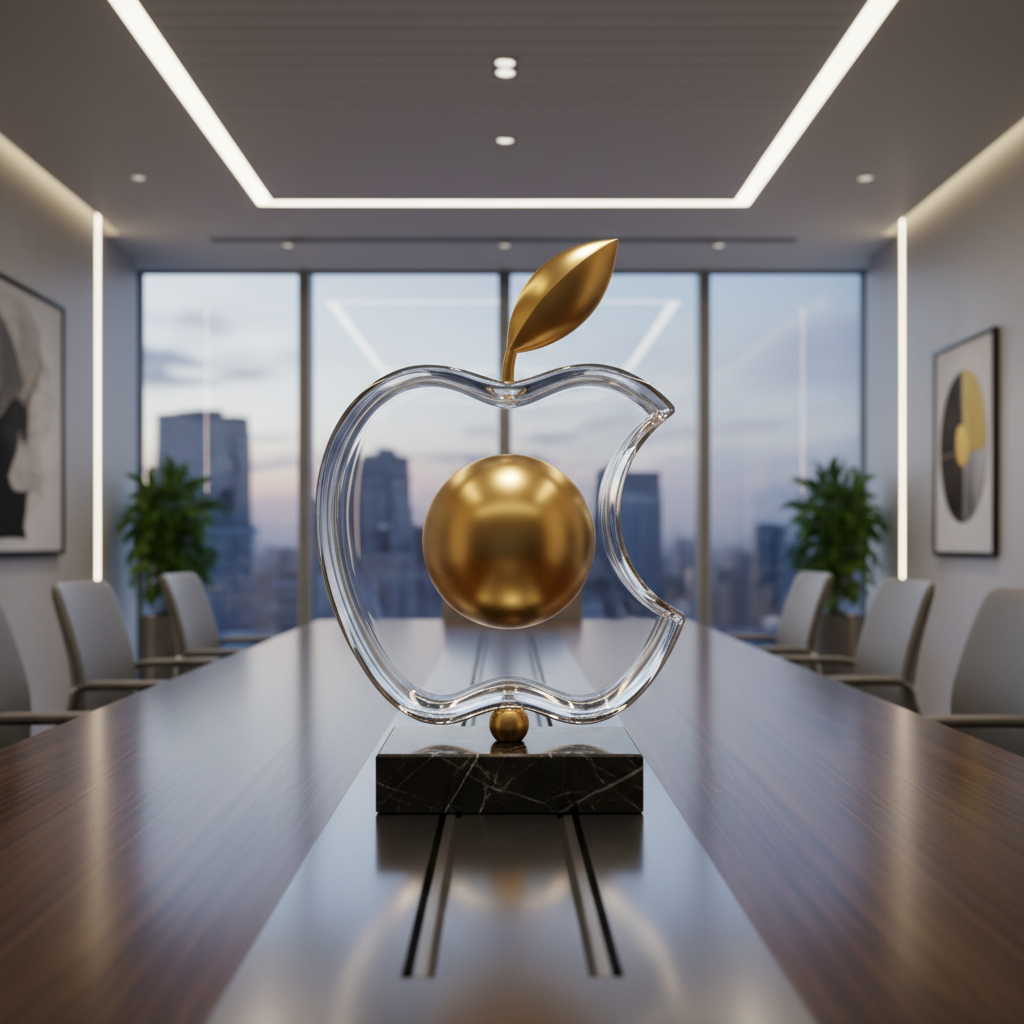
Cook presented Trump the special statue on Wednesday, in a meeting that also included Apple’s new $100 billion investment commitment. The customized iPhone logo statue is a large glass circle that has been cut in such a way that a very large Apple logo remains in its center. As Apple CEO Tim Cook said, the logo was made out of 24-karat gold and had an engraved base made of glass with Trump’s name on it. The statue, from Utah, was made by Corning, an Apple supplier that produces specialty glass for iPhones. The piece was created by a former U.S. Marine Corps corporal who now works at Apple, Reuters reported. Cook finished it off with a personalized message that read “Made in America.” Cook signed the message, according to Reuters.
For a president who has consistently demanded that corporations make more products at home, the symbolism couldn’t have been lost on Trump. At the meeting, held in the Oval Office, Trump said that Apple will be among the companies that “pay no charge” on the semiconductor tariff when the move is formally put in place. It’s a big win for Apple, which has been subject to months of public shaming by the president about the supply chain location.
It’s been a tough spring for Apple. Trump had earlier taken the company to task for transferring part of iPhone production to India rather than shifting the labor and manufacturing facilities to the U.S. In one instance, he said he would make sure tariffs would increase to 25 percent for Apple if the company didn’t make iPhones at home. In April, Trump bragged that his trade policies would yield “Made in America” iPhones. A month later, the president was more visibly frustrated, suggesting he had a “little problem with Tim Cook” during a visit to the Middle East. The Washington Post reported that in a phone call, Trump said to Cook, “We are treating you really good, we put up with all the plants you built in China for years. We are not interested in you building in India.”
Analysts have pointed out for years that shifting the iPhone production line to the U.S. will be extremely difficult if it is possible at all. The president, not to be outdone by reality, continued to spin the goal as if it were just around the corner. In May, Commerce Secretary Howard Lutnick said that Apple is “looking at robotic arms” to re-create the kind of pinpoint accuracy found in China-based iPhone assembly lines.
Despite Trump’s claim, the events of Wednesday indicate the president has dialed back his demands. While Trump earlier said Apple would be subject to a 25 percent tariff if it didn’t start iPhone assembly in the U.S., he now calls Apple’s actions “a significant step toward the ultimate goal of ensuring that iPhones sold in America also are made in America.” For now, he is walking back the immediate demands.
Cook has since confirmed that “some” iPhone parts, like semiconductors, glass, and Face ID modules, are made in the U.S. He offered no specific date on when final assembly will be completed domestically, however. Instead, Cook suggested that some of that work would stay overseas “for a while.”
It’s been something of a playbook for Cook. The CEO engaged Trump’s ego during the previous term, promising new investment at home but never fully acquiescing to his most aggressive demands. Trump in 2017 bragged that Apple would build three new “big, beautiful” plants in the U.S. Only one went up—and it made face masks. Another Trump moment from 2019 saw the president tour a new Texas plant. The facility, Trump said at the time, would be making iPhones in the U.S. Instead, Apple put the plant to work on MacBook Pro production.
Apple now says it will invest $600 billion in the U.S. in the next four years. But that’s a big number. And analysts tell Reuters that Apple would have been on track to spend that money anyway. In other words, the new investment goal may not be new at all. Apple’s spending has, Reuters notes, been steady through both the Biden administration and Trump’s first term. So while Trump has threatened that companies that don’t step up could retroactively face tariffs, Apple is merely following its existing plan, keeping iPhone assembly abroad and not changing its investment calculus. At least for now, Trump has decided not to push.
Apple has a “savvy solution to the president’s demand that Apple manufacture all iPhones in the U.S.,” Nancy Tengler, CEO and CIO of Laffer Tengler Investments, which holds Apple shares, told Reuters. Tim Cook has bought Apple some time in the trade war. Trump wants to spin this as progress towards “Made in America” iPhones. The truth is, Apple has no real plans to upend decades of established manufacturing in Asia. For now, Wall Street appears to like Apple’s dance.