- calendar_today August 7, 2025
The Rise of AI in Entertainment – How It’s Changing Music, Movies, and More (Especially Here in Washington D.C.)
artificial intelligence is transforming film, music, and creative technology in Washington D.C., from local studios to digital art spaces and beyond.
AI is Finding Its Voice in D.C.’s Music Scene
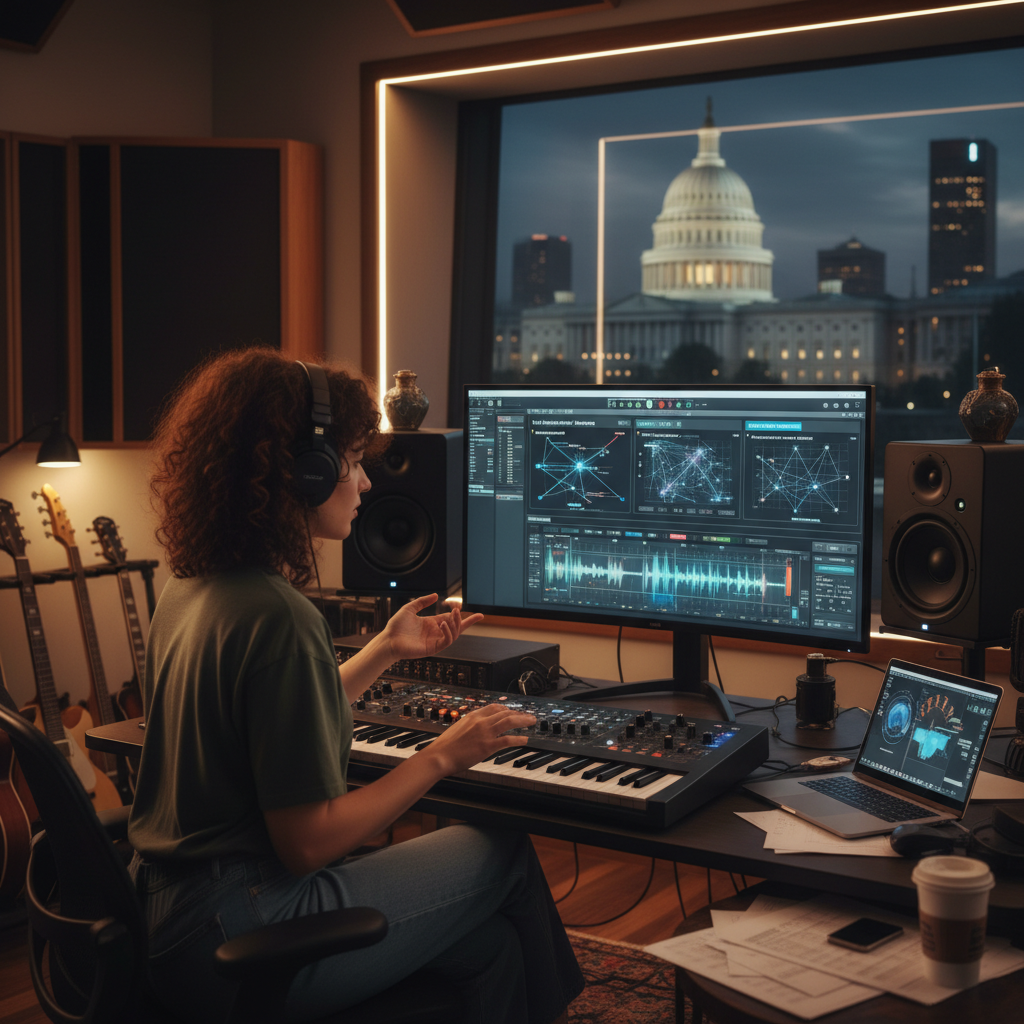
Walk down U Street on any weekend night and you’ll hear the pulse of go-go music, D.C.’s homegrown sound. But while the rhythms are still rooted in tradition, there’s something new happening in local studios—AI music tools are quietly becoming part of the process. Producers are experimenting with software that suggests melodies, mimics vintage drum machines, or fine-tunes vocal mixes.
A producer I met in Petworth said, “I use AI to sketch out song ideas fast. It’s not replacing the band—it’s just helping us try more ideas in less time.” In a city known for innovation and activism, it makes sense that artists are using tech not to erase culture, but to evolve it.
Filmmakers in the Capital Are Tapping Into Smart Tools
Washington D.C.’s independent film scene might not be as flashy as Hollywood, but it’s powerful—and personal. Documentaries, political dramas, and experimental shorts often find their roots right here. Lately, more filmmakers are starting to use AI to streamline parts of the production process.
One director I met at a screening in Brookland told me she uses AI-assisted editing to cut down rough footage. “It doesn’t do everything, but it saves hours. And that gives me more time to focus on the story.” When budgets are tight and time is precious, AI is quickly becoming a quiet partner behind the lens.
Museums, Murals, and Machines: AI in D.C.’s Art World
D.C. isn’t just monuments and politics—it’s packed with creative spaces, from underground galleries to iconic institutions like the Smithsonian. Now, AI is showing up in these places too, helping artists reimagine how work is created and displayed.
At an exhibit near Dupont Circle, I saw a digital installation where AI altered visitors’ faces into surreal artworks in real time. One artist told me, “I see AI as a brush, not a replacement.” With so many young artists in the city blending code and canvas, AI-generated art is starting to feel like the next wave—not a fad.
Gaming and Storytelling in the Nation’s Capital
D.C. has a growing tech community, and that includes creatives working at the intersection of design, storytelling, and game development. At George Washington University and Howard, students are using AI to build interactive narratives, simulate characters, and map complex story branches in real time.
One student showed me a game where the storyline adapts to your voice tone. “We trained an AI model on thousands of voice samples,” he said. “The goal is for the game to actually feel you.” That kind of interactive storytelling is exactly the kind of innovation D.C. has always nurtured—smart, bold, and human-centered.
But What About the Soul of Creativity?
With all this technology, people are asking the big question: will human creativity get lost in the machine? Can something written by an algorithm move people the way a handwritten verse or brushstroke can?
Honestly, that’s a fair concern. But what I’ve seen here in D.C. suggests the opposite. Artists are using AI to expand what’s possible—not shortcut the process. They’re still the ones telling the story, painting the picture, playing the beat. Creative authenticity isn’t going anywhere; if anything, it’s being redefined in real time.
Final Thoughts
Washington D.C. may be best known for politics, but its creative technology scene is growing fast—and AI is right at the center of it. Whether it’s in music studios, museum halls, or behind the scenes on a film set, artists are finding new ways to bring their ideas to life.
And what’s cool is how collaborative it all feels. D.C. is a city of thinkers and makers, of policy and poetry. Maybe that’s why AI here feels more like a tool than a takeover. People are shaping it, questioning it, using it to push boundaries instead of replacing what matters most.
The future of D.C. creativity won’t be written by machines—but it might be co-written. And honestly? That sounds kind of exciting.