- calendar_today August 12, 2025
.
Washington and New Delhi cultivated one of the most fruitful partnerships among countries in the post–Cold War period, dating back over two decades. Now, a relationship founded on diplomatic and defense collaboration is approaching one of its most significant challenges as it unravels amidst a lack of trust and the accompanying drama of tariffs, oil, and realpolitik.
“We’re in a situation in the U.S.-India relationship where the premises and assumptions of the last 25 years — that everybody worked very hard to build, including the president in his first term — have just come completely unraveled,” Evan Feigenbaum, a South Asia expert at the Carnegie Endowment for International Peace, said bluntly. “The trust is gone.”
After the Trump administration levied broad tariffs on India this year over its ongoing purchase of Russian oil, despite its use of discounted barrels at a time of war in Ukraine, the ties between Washington and New Delhi have sunk to a new low. The tariff, which began at 25 percent, is expected to increase to 50 percent on August 27. Instead of pressuring India to change course on its oil buying, the tariff has instead nudged New Delhi closer to Moscow and, by some measures, to Beijing as well.
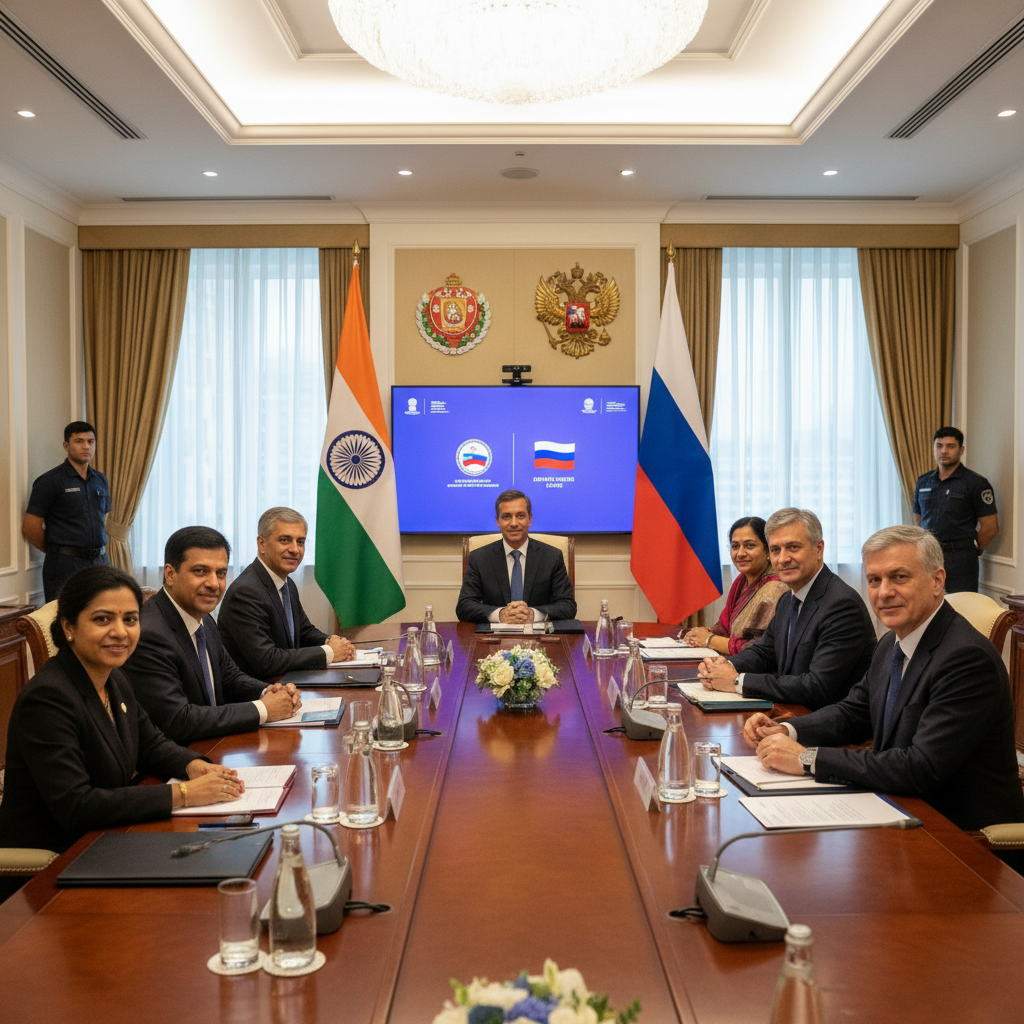
In the last few weeks alone, India’s national security adviser visited Moscow, as did Foreign Minister Subrahmanyam Jaishankar, before Chinese Foreign Minister Wang Yi concluded talks in New Delhi. Prime Minister Narendra Modi is also preparing for his first visit in over seven years, while Russian President Vladimir Putin is also expected to host Modi in Moscow by the end of the year, analysts say. The eastward drift has real-world consequences.
Indian public sentiment has also soured over what New Delhi views as U.S. interference in sovereign decision-making. “They’re signaling very clearly that they view that as interference in India’s foreign policy, and they are not going to put up with it,” Feigenbaum added.
Indian state-run refiners have not ordered Russian crude since the start of the war in Ukraine after Trump’s tariffs, according to Reuters, but resumed imports after discounts of six to seven percent. Russian oil now comprises 35 percent of India’s total crude imports, compared to 0.2 percent before Russia invaded Ukraine. Sensing an opportunity, Moscow has also upped its discount offerings. Deputy Prime Minister Denis Manturov said Russia is “going to continue to supply crude oil, oil products, thermal and coking coal to India” and has “potential for the export of Russian LNG as well.”
The price cuts have drawn significant interest from New Delhi as it eases some of its restrictions. But Indian officials have been rethinking Washington’s relations with Moscow for some time. Michael Kugelman, a South Asia analyst in Washington, D.C., pointed to the fact that Trump’s tariff is “one part of a series of reasons why India is engaging Russia so closely right now.”
While some of India’s recent moves are likely “posturing,” he added, other decisions “have the potential to be much more serious and lasting.”
The Trends
India had begun to pivot from its traditional arms procurement relationship with Russia before Russia’s war in Ukraine, making up for that gap by diversifying with the U.S., French, and Israeli systems. But when Russia invaded, India’s energy trade with Moscow picked up by leaps and bounds. “This is a signal coming from the Indians that the U.S. can’t be trusted, whereas Russia can — because Russia is always going to be there for India no matter what,” Kugelman said.
Modi has also used the opportunity to underscore for a domestic audience that he is an upholder of the nation’s sovereignty. The Indian prime minister has placed a priority on ensuring the livelihoods of the country’s farmers, small businesses, and young workers, language with deep political meaning for the domestic audience. “India has already made these concessions to Washington, on the tariff reductions and also on the returning Indian workers,” Kugelman noted, recalling earlier in the war that India had already given the U.S. most of what it wanted. “Because of those concessions, India needs to be careful about signaling further willingness to bend. This is one reason there was no trade deal — Modi put his foot down.”
In Washington, Frustration Is Brewing
Writing in the Financial Times, former White House trade adviser Peter Navarro branded India’s oil buying as “opportunistic” and “deeply corrosive.” Navarro claimed that tariffs were “appropriate” as a way to impact India, where it hurts — its access to U.S. markets — even as it seeks to cut off the financial lifeline it has extended to Russia’s war effort.”
The plummeting relationship is a far cry from earlier high-water marks in the partnership, like the 2008 U.S.-India civil nuclear deal, which gave India access to American fuel and technology despite the nation’s non-signatory status to the Non-Proliferation Treaty. At the time, both countries were able to compartmentalize differences to ensure disagreements on some issues didn’t hamstring cooperation on others.
These days, it’s different. The United States has long viewed India as the indispensable democratic partner to contain China in the Indo-Pacific approach that Obama, Trump, and Biden have each run on. But as the cracks begin to leak from the trade disputes into areas such as defense and intelligence cooperation, the foundation of that relationship is becoming much less secure.
“Countering China has been the glue binding this relationship,” Kugelman said. “But if the U.S.–India relationship continues this free fall, it will be very difficult to sustain.”
Feigenbaum notes the irony of the moment: “Then, India was leveraging its partnership to signal to then-foe China that it had options. Now they’re working with the Chinese to signal Washington rather than the other way around.”
The message India is sending is clear. It will chart its course, even if that means cozying up to America’s rivals.