- calendar_today August 16, 2025
.
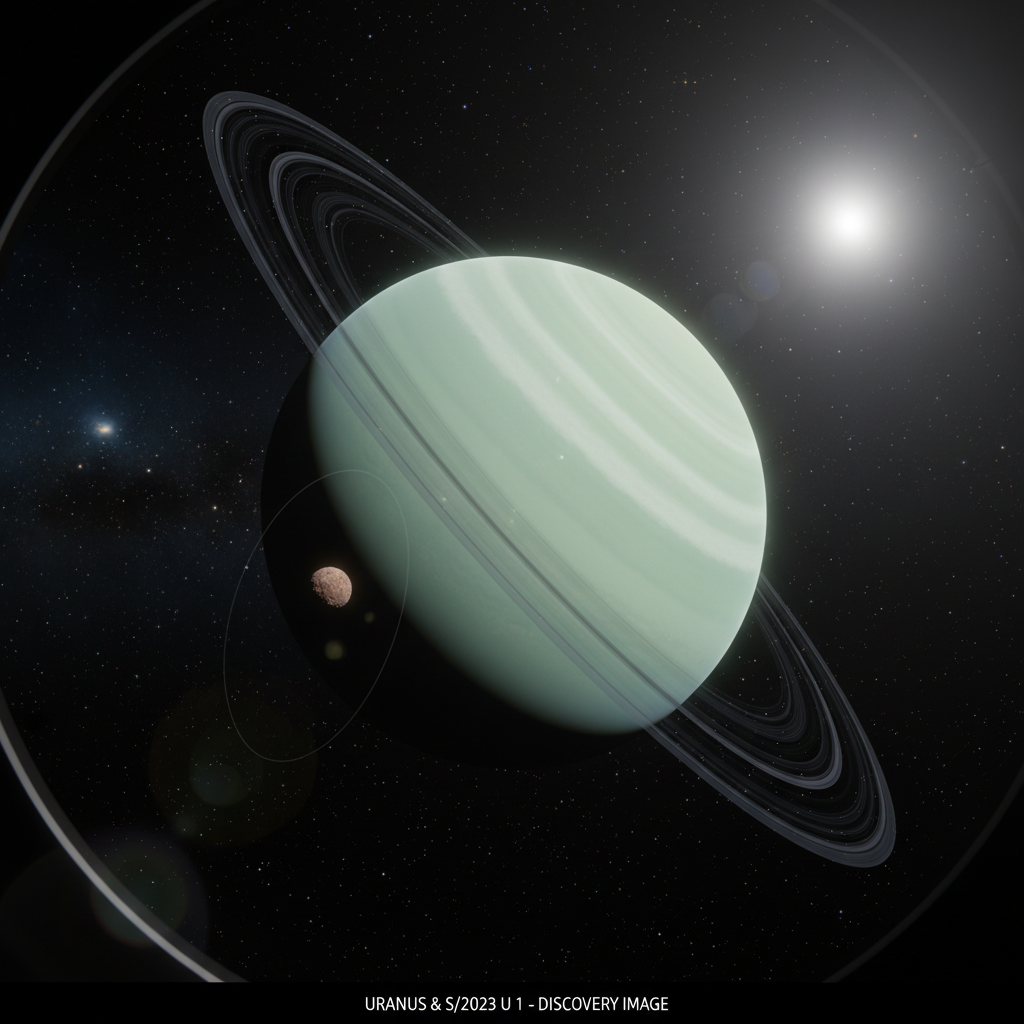
With 29 moons already in its known system, astronomers are now reporting another addition to the icy giant planet’s entourage. The new moon, about 6 miles (10 kilometers) across, was spotted by the James Webb Space Telescope (JWST). Researchers are sure that many more remain undiscovered.
The dim object was first seen on Feb. 2 in a set of 40-minute long-exposure images taken by Webb’s Near-Infrared Camera. One of the smallest moons of Uranus ever discovered, the tiny satellite is hidden by the glare of Uranus’ rings and by its own tiny size. Even NASA’s Voyager 2 spacecraft, which swept by Uranus about 38 years ago, didn’t see it.
“This is a small moon but a significant discovery,” said Maryame El Moutamid, lead scientist in the Southwest Research Institute’s Solar System Science and Exploration Division in Boulder, Colorado. El Moutamid is also the principal investigator for a Webb program dedicated to exploring Uranus’ rings and inner moons. “It shows that Webb is opening up a new era of discovery well beyond that of previous missions.”
The object, currently called S/2025 U1, is located 35,000 miles (56,000 kilometers) from the center of Uranus. It orbits the planet in nearly the same plane as Uranus’ equator and rings, and is between two other known moons. The moon orbits just beyond the planet’s main ring system (the epsilon ring), where it is sandwiched between the known moons of Ophelia, just beyond the rings, and Bianca. S/2025 U1 is likely to have formed where it orbits today, given its nearly circular orbit.
Because the moon is so small and dark, and it orbits very quickly, astronomers had a hard time teasing it apart from the brighter glare of Uranus itself and its rings. Webb is designed to detect the faint infrared light from distant objects, which was key to the discovery. The telescope has already given astronomers new views into Uranus’ rings, weather, and atmosphere, and this discovery continues that record.
Solving the Uranus Mystery
“This discovery marks an exciting time for Uranus and its unique and complex system,” said El Moutamid. “S/2025 U1 also raises questions about how many more small moons might remain hidden around Uranus and how they might interact with the planet’s rings.” The newly discovered moon may be related to the planet’s ring system. Scientists think that S/2025 U1 and portions of Uranus’ rings may have a common origin: the two may be fragments left over from the same ancient event.
Currently, there are five large major moons—Miranda, Ariel, Umbriel, Titania, and Oberon—plus a swarm of smaller satellites. The discovery is the 14th small moon in the inner system. No other planet has as many small inner moons packed together so closely, and astronomers are stumped as to why. The satellites are close enough together that their orbits should cross, yet they remain in lockstep. Astronomers think that many of the moons help shepherd Uranus’ narrow rings, keeping them from dissipating.
“It’s a very exciting discovery,” said Scott Sheppard, an astronomer at the Carnegie Institution for Science who was not involved in the new study but who co-discovered a Uranus moon in 2024. “The object is very close to Uranus’ inner ring system, so it’s extremely relevant in terms of understanding the origin of the system,” he added. “And it was only possible to discover this thing with the amazing sensitivity of Webb.”
The SETI Institute’s Matthew Tiscareno, co-principal investigator in the Webb Uranus program, said, “Our discovery highlights how the boundary between the moons and rings around Uranus is not as obvious as we once thought.” Tiscareno added, “The complex inter-relationships of these satellites with the ring system also hint at a chaotic past.” The new moon was actually smaller and fainter than the five known inner moons, each less than a mile (kilometer) wide. “This strongly suggests that other small satellites are yet to be discovered.”
Slowly, the moons of Uranus have been uncovered. Before Voyager 2’s historic flyby in 1986, only five moons had been discovered, the biggest ones visible with pre-telescopic technology as far back as 1787. Voyager 2 saw 10 more moons as it passed Uranus, each with diameters between 16 and 96 miles (26 to 154 kilometers). Since then, more ground-based telescopes and the Hubble Space Telescope have spotted another 13 small moons. Each is 8 to 10 miles (12 to 16 kilometers) across, darker than asphalt, and further out. El Moutamid and her team have found the other 13 moons orbiting between Miranda and Oberon.
Sheppard thinks that there are more moons, as small as a few kilometers across, just waiting to be discovered, either with long-exposure Webb images or with future spacecraft. El Moutamid and her team will continue to track down more by refining the orbit of S/2025 U1 and tracking down more hidden satellites.
“A new moon around Uranus helps scientists better understand how its strange system formed, and can shed light on its rings, as we continue to explore the system and prepare for future missions like NASA’s Uranus Orbiter and Probe,” El Moutamid said.