- calendar_today August 11, 2025
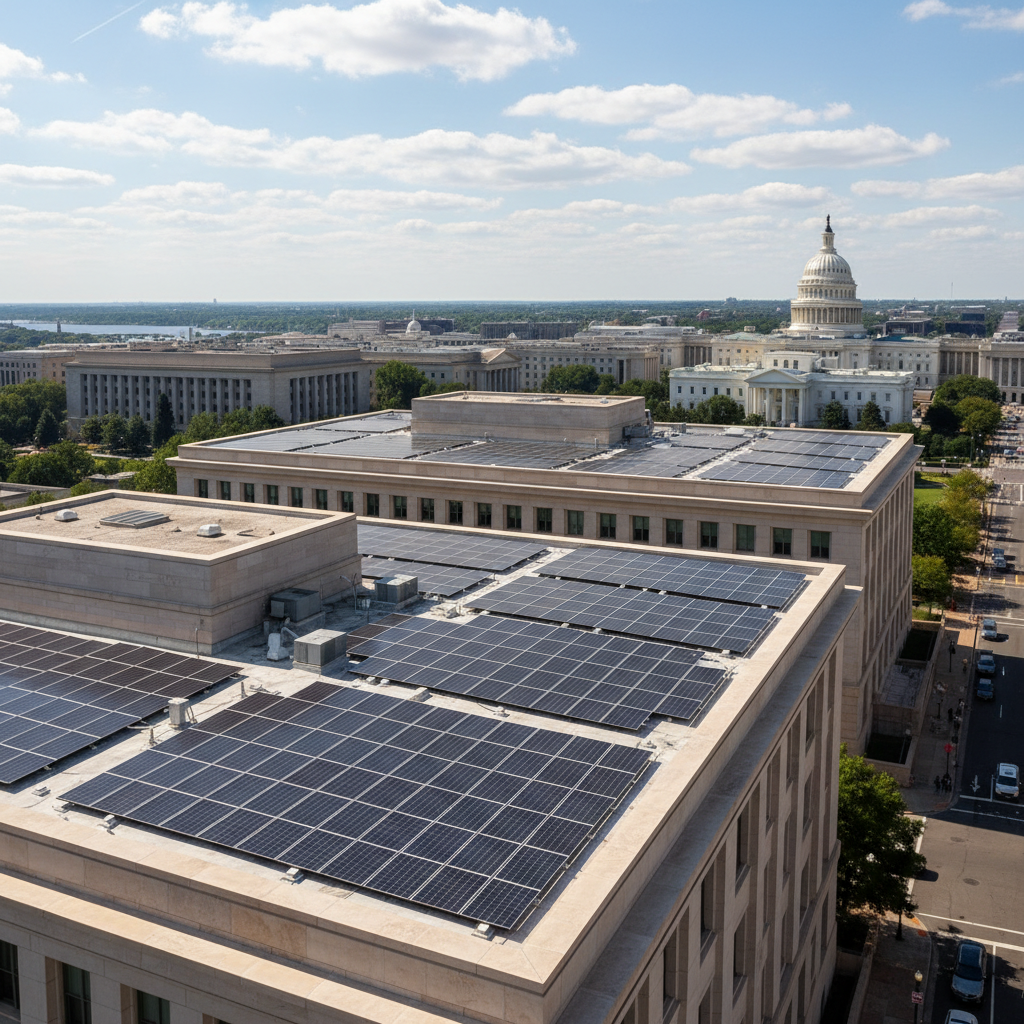
By May 2025, Washington D.C. is buzzing with more than politics—it’s humming with solar projects on federal buildings, clean energy job fairs, and aggressive carbon-neutral campaigns. The city, often seen as the control room for national energy policy, is doubling down on its commitment to climate goals. Yet in the stock market, green energy equities remain sluggish.
This divergence between policy momentum and stock performance has left many D.C.-based investors and analysts in a state of cautious curiosity. If the nation’s capital is pouring billions into decarbonization, why isn’t Wall Street responding?
Policy-Driven Climate Action Dominates D.C.’s Energy Landscape
Following the expansion of the Inflation Reduction Act (IRA) and the 2024 Clean Energy Investment Acceleration Order, Washington D.C., has become ground zero for the nation’s transition to a low-carbon economy. As of 2025:
- Over $120 billion in federal contracts have been allocated to clean energy firms through climate tech accelerators, green bank grants, and DOE partnerships.
- The Department of Energy’s Loan Programs Office (LPO) is backing innovative startups in battery storage and hydrogen infrastructure.
- Every federal agency is now required to meet energy use benchmarks—pushing demand for solar retrofits, EV fleets, and energy-efficient buildings.
The city itself is installing solar panels across public schools, libraries, and Metro transit facilities, adding to its already robust clean energy portfolio. In fact, the D.C. Department of Energy and Environment (DOEE) announced that over 85% of municipal buildings will operate on renewables by Q4 2025.
Clean Jobs and Public-Private Coalitions Drive Local Impact
The impact isn’t just political. Washington D.C. is seeing real job growth in the green sector. According to the Bureau of Labor Statistics, clean energy jobs in the DMV area (D.C., Maryland, Virginia) grew 17% in the last 12 months—twice the national average.
Several local partnerships are worth noting:
- The Clean Energy Career Hub, launched in early 2025, connects young professionals and veterans to federal grant-backed training programs in solar, wind, and EV infrastructure.
- Amazon Web Services (AWS) has expanded its D.C. data center operations, sourcing energy from regional wind farms and contributing to grid decarbonization.
Despite this, many of the companies leading these changes aren’t publicly traded—or they’re smaller, private startups. That disconnect is part of the stock market puzzle.
Green Energy Stocks Remain a Rollercoaster
While D.C. policies are moving clean energy forward, the investment side tells a different story. Major green ETFs like iShares Global Clean Energy (ICLN) and Invesco Solar ETF (TAN) have struggled to regain their pandemic-era highs. Even after D.C.’s 2025 federal funding surge, investors remain skeptical due to:
- Profitability Delays: Startups benefiting from government grants often operate at a loss, and their success can take years to materialize in shareholder returns.
- Interest Rate Pressures: Even with inflation cooling in Q1 2025, the Fed’s rates remain sticky, putting pressure on capital-intensive sectors like renewables and infrastructure.
- Election-Year Anxiety: With a contentious 2024 election fresh in memory and policy rollbacks possible post-2026, investors are hesitant to fully commit.
Smart Picks: How D.C. Investors Can Navigate the Gap
For local investors looking to align their portfolios with what’s happening on the ground, several strategic options are emerging:
- Brookfield Renewable Partners (BEP): While based in Canada, Brookfield has major U.S. assets and is a frequent DOE project partner.
- NextEra Energy (NEE): With strong federal ties and a blend of solar, wind, and transmission infrastructure, NextEra remains a long-term play.
- Energy Impact Partners (EIP): Though not a stock, this D.C.-connected investment firm runs multiple clean energy-focused funds, some of which are opening to accredited investors.
And for those looking beyond stocks:
- Green municipal bonds issued by the D.C. government to fund infrastructure and energy projects have seen solid demand, offering stable yields with environmental impact.
Washington D.C., may not house giant solar farms or EV factories, but it holds the pen that writes the rules and signs the checks. For now, that power hasn’t translated into a full-scale market rally. But for investors who understand the long game of energy transitions, the capital’s clean momentum may prove to be an early signal, not a lagging indicator.