- calendar_today August 14, 2025
.
Electric vehicle sales in the United States are hitting a wall. After nearly 14 straight months of month-over-month sales increases, sales of EVs declined in August, signaling a shift in consumer sentiment that has already led to notable brands like Genesis and Volvo scaling back their EV ambitions.
The move also comes against a political backdrop of reduced subsidies and weakened vehicle pollution standards under the current administration. That has left the federal government with little incentive to encourage potential EV buyers. But according to industry analysts, the biggest impediment to U.S. EV adoption may not be in Washington D.C. but in America’s garages.
Consumer surveys have long identified range anxiety and charging availability as the primary obstacle to U.S. EV adoption. A new report from Telemetry Vice President Sam Abuelsamid further elaborates on this issue, pointing to a relatively under-discussed sticking point: garage use.
While it’s true that many EV drivers rely on DC fast chargers when on the go, the majority of charging occurs at home. A recent report from the National Renewable Energy Laboratory (NREL) found that around 80 percent of EV charging was done using AC power, most of it in single-family residences.
In fact, the same NREL report found that around 42 percent of American homeowners are already parked near an outlet capable of delivering level 2 (240-volt) charging.
Abuelsamid’s analysis from Telemetry paints a more optimistic picture. His report estimates that, if they were to declutter their garages and park their vehicles inside, as many as 68 percent of all American homeowners could charge an EV at home.
Based on Telemetry research, “90 percent of all houses can add a 240 V outlet near where cars could be parked,” the report states. “Parking behavior, namely whether homeowners use a private garage for parking or storage, will likely become a key factor in EV adoption.”
Opening up just a single spot in a garage for parking instead of storage would increase the number of homes able to charge an EV at home from 31 million to over 50 million. Allowing for homes in which new wiring is required, the total jumps to more than 72 million. That easily tops Telemetry’s most bullish EV penetration forecasts for 2035, which range from 33 to 57 million vehicles.
Garage clutter isn’t the only thing blocking the way to such dramatic expansion. The same NREL study found that nearly 34 million homes across the country would need a significant electrical upgrade to support a level 2 charger, which often requires 30 amps or more of power. The cost of these upgrades, which can range from new wiring to an entire panel replacement, can run into the thousands of dollars.
This cost impediment immediately discredits one of the primary EV value propositions: long-term cost savings over gas-powered vehicles. With the additional cost of wiring and installation added to the up-front sticker price, the lifetime cost of ownership for an EV starts to look far less attractive than it did.
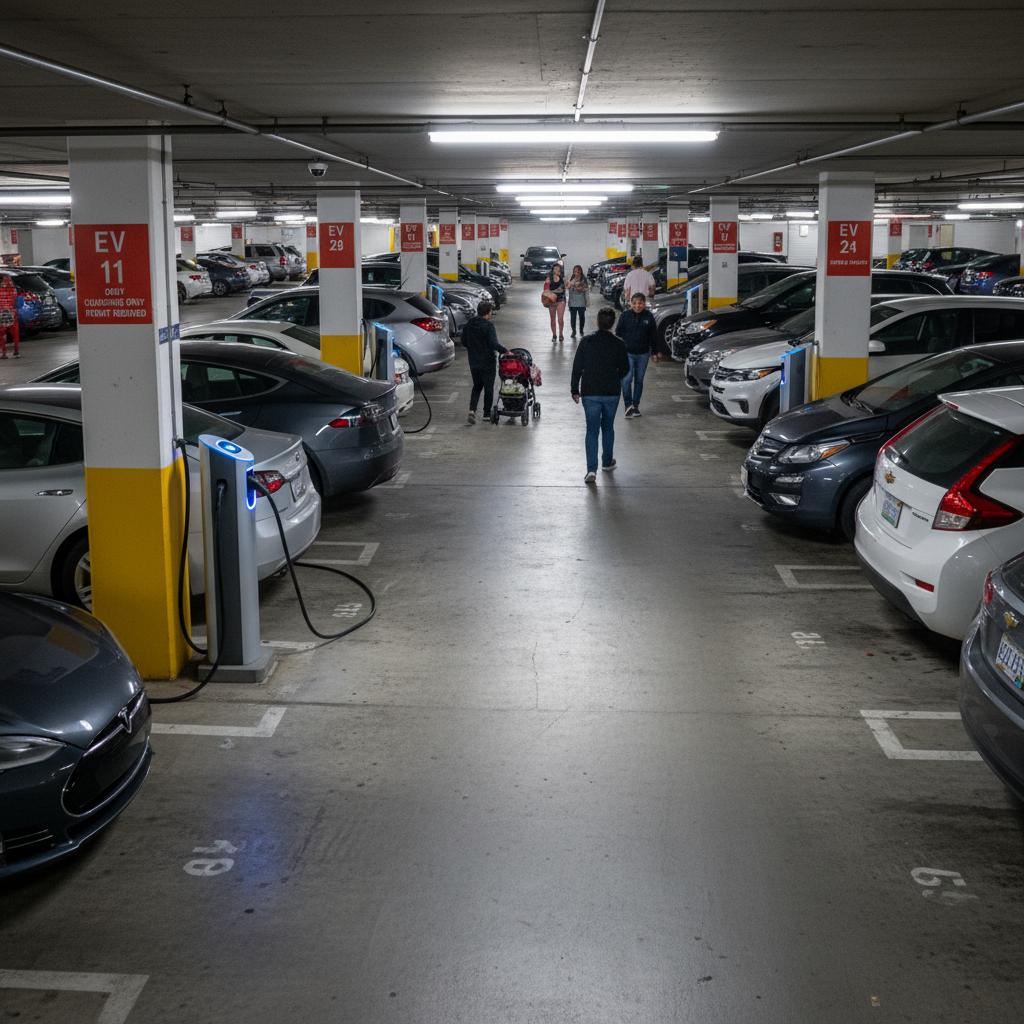
The situation for the roughly 23 percent of Americans who live in multifamily housing is even less rosy. In this context, individual EV owners generally can’t simply install a charging station at will. They must appeal to landlords, management companies, and sometimes co-op boards to do so. Such permissions are not always forthcoming.
In addition, the cost of installations are much higher in multifamily dwellings. A landlord who wants to add a pair of shared level 2 chargers in a co-op building, for instance, may first have to upgrade the electrical panel at significant expense. Wiring and running conduit to parking spots that are not near a panel also add to the cost of installations. To further complicate matters, residents in multifamily housing are less likely to qualify for municipal or utility rebates or subsidies for chargers.
Currently, there are about 1 million EVs in multifamily housing in the U.S., but just 11 percent of them park near an outlet capable of charging an EV. Even where state mandates require developers to equip 20–25 percent of parking spaces in multifamily developments with EV-ready outlets, Telemetry calculates that there will be only 6.7 million to 11.4 million charging-capable spaces in all multifamily dwellings by 2035. That will still be short of the estimated demand.
With home charging such an inexact science, public charging infrastructure will be required to fill the gap. Telemetry estimates that between 11.7 million and 14.3 million EV drivers who own homes will still depend on public charging to some degree in 2035, as will an additional 7.8 million to 8.1 million EV owners who live in multifamily residences.
Meeting that need will require between 523,000 and 586,000 DC fast chargers, as well as an additional 1.5 million to 1.6 million level 2 chargers. But building out that kind of infrastructure is easier said than done. Utilities are already operating near capacity, and the massive power demands of new AI-driven data centers are further crowding out new generation and transmission capacity, as well as causing local issues with the siting of large-scale charging sites.
It’s not all bad news for EVs in the U.S. But the heady days of exponential growth in American EV adoption are likely over. The confluence of factors from garage clutter to high electrical upgrade costs to the challenges of multifamily living make the United States a more difficult market for EVs than it might seem. Even with an aggressive push to expand public charging infrastructure, supply will likely struggle to keep pace with demand in the next decade.