- calendar_today August 9, 2025
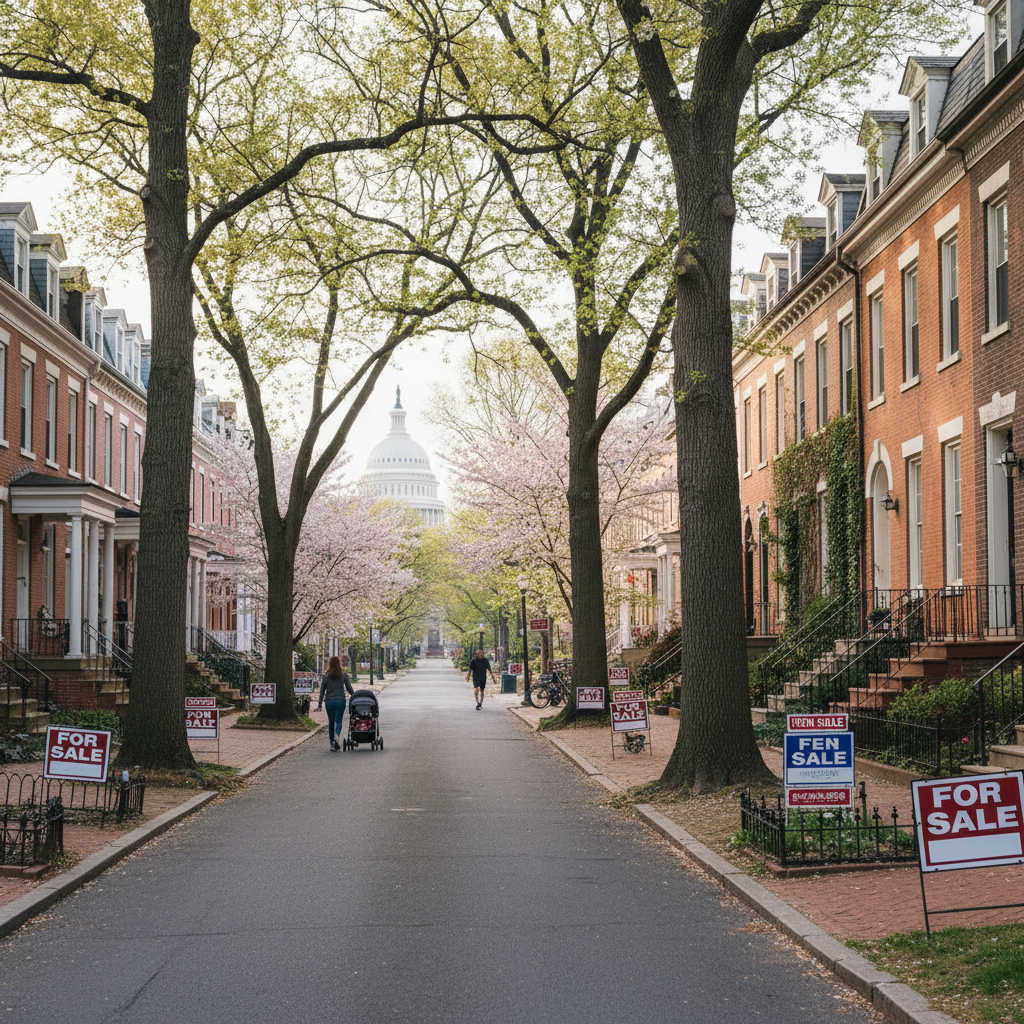
In 2025, Washington D.C.’s housing market is experiencing a noticeable slowdown. While the city isn’t seeing a crash, the once-booming residential real estate activity that characterized much of the 2010s and early 2020s has lost momentum. Real estate professionals describe a freeze — not in prices, but in movement. Buyers are hesitant, sellers are waiting, and many listings are sitting for weeks longer than usual.
“The D.C. market hasn’t dropped off a cliff, but it feels stuck,” says Amanda Carlisle, a realtor with Capitol Property Group in Logan Circle. “There’s demand, but there’s also caution — and that’s creating a strange stillness.”
Mortgage Rates Cast a Long Shadow
One of the biggest culprits behind this market freeze is the elevated interest rate environment. Despite the Federal Reserve signaling potential cuts in late 2025, mortgage rates remain in the 6.8%–7.2% range — a far cry from the sub-4% loans that powered earlier homebuying booms.
For many would-be D.C. buyers, especially first-timers, these rates are a dealbreaker.
“Even with steady employment, the monthly payment jump at current rates is staggering,” notes local mortgage broker Tanisha El-Mansour. “Buyers who were pre-approved in 2022 are now seeing 20–30% less purchasing power.”
This has put downward pressure on activity, even as prices remain relatively flat due to constrained inventory.
Affordability Has Reached a Tipping Point
Affordability was already a challenge in the District, but in 2025, it’s become a barrier to entry for many. According to data from Zillow and Redfin, the median home price in Washington D.C. hovers around $650,000. In popular neighborhoods like Capitol Hill, Dupont Circle, and Columbia Heights, that number can exceed $800,000.
This is pricing out a large swath of buyers, particularly younger professionals and public-sector workers.
“People working in government, education, or health care just can’t compete,” says housing advocate Malik Weston of D.C. Housing Watch. “Wages aren’t keeping pace with the cost of owning in D.C., and many are giving up and looking in Maryland or Virginia.”
Inventory Is Up, But It’s Not Moving
Interestingly, housing inventory in D.C. has ticked up in 2025. But that hasn’t led to a more dynamic market. According to MLS data, the average days on market for homes in the District is now over 48 days — nearly double the average in 2022.
The reason? Sellers are reluctant to adjust prices downward, even when buyers are hesitant.
“There’s a standoff happening,” says Carlisle. “Sellers think their homes are worth 2021 numbers. Buyers are working with 2025 rates and budgets. No one’s budging.”
As a result, many homes linger on the market or are taken off altogether, awaiting a future rebound.
Investor Interest Has Cooled — For Now
Washington D.C. has long attracted real estate investors, including international buyers and institutional investors. But the calculus has changed in 2025.
Rising carrying costs, flat rental yields, and higher taxes have led many investors to hit pause on new purchases in the capital. Several condo developments that were slated for launch this year have either delayed or scaled back marketing efforts.
“The investor appetite for D.C. isn’t gone, but it’s more selective now,” says Jonathan Tsu, a real estate investment analyst based in Rosslyn. “Everyone is waiting to see if rates drop and how politics affect the economy in the next six months.”
Policy Uncertainty Is Adding to the Chill
Adding to the freeze is uncertainty over housing policy at the federal level. With the 2026 midterms approaching and debates intensifying over rent control, housing subsidies, and urban development incentives, many developers and buyers are in wait-and-see mode.
“D.C. is a unique market because what happens in Congress often affects demand here directly,” explains urban policy expert Rachel Yoon. “Right now, people are holding their breath until they see what comes next.”
Additionally, local policies like Mayor Muriel Bowser’s proposed rent stabilization expansion and potential changes to property tax exemptions are causing hesitation among landlords and multi-family investors.
Rental Market Is Steady — But Not Booming
While the homebuying market is frozen, the rental sector has remained relatively stable. Average rent for a one-bedroom apartment in D.C. is around $2,400 in mid-2025, according to RentCafe. This represents a modest 2% year-over-year increase.
Still, landlords are finding it harder to raise rents aggressively or flip rental properties profitably, especially with more tenants pushing back and new laws aimed at tenant protection being proposed.
“In a frozen sales market, you’d expect rents to spike,” says Weston. “But that hasn’t happened — probably because affordability limits have been reached there, too.”
Will D.C. Thaw in Late 2025 or 2026?
There is cautious optimism among some analysts that D.C.’s housing market could begin to thaw by early 2026 — but only if mortgage rates come down meaningfully and buyers regain confidence.
If the Federal Reserve implements one or two rate cuts by Q4 2025, and job growth in the metro area remains stable, the stage could be set for a moderate rebound.
But for now, industry insiders believe the stalemate will continue through the end of the year.
A Balanced Freeze, Not a Crash
Unlike the 2008 financial crisis, the 2025 housing freeze in Washington D.C. is not characterized by panic or distress. Instead, it’s marked by a stalemate between pricing, policy, and affordability.
“The fundamentals of D.C.’s housing market remain strong,” says Carlisle. “But psychology is playing a big role this year. People are just more cautious — and that’s hard to fix with one rate cut or incentive program.”
Until that changes, Washington’s housing market will likely remain on pause — waiting, like much of the nation, for clearer economic skies.